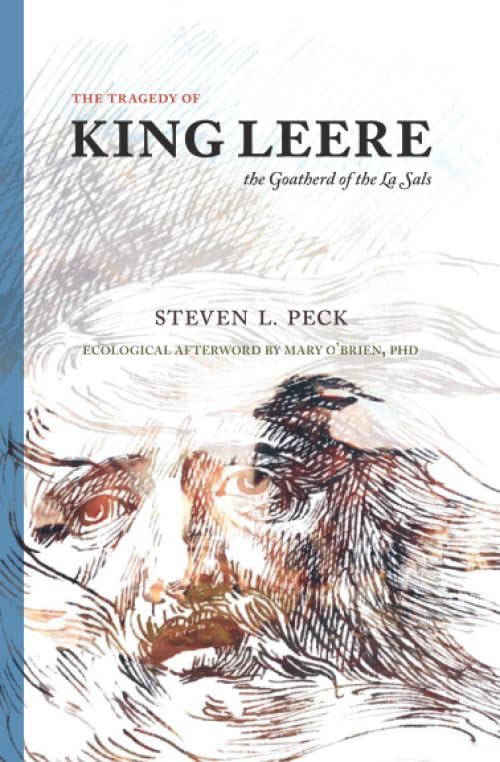
The Tragedy of King Leere, Goatherd of the la Sals

The Tragedy of King Leere, Goatherd of the la Salsicon

by Steven L. Peck

Publisher
By Common Consent Press
Publication
Mar 26, 2019
Format
Paperback/Softback
Illustrated
No
Dimensions
5.25 x 8 x 0.63 in
ISBN
978-1948218016
ASIN
1948218011
Pages
251
Age
Adult 18+
Category
General FictionLiterary FictionScience Fiction

Rights Sold

🌍 World Wide Rights Available

Description

Like those three dimensional objects that look entirely different depending on the angle from which you view them, this novel presents a number of faces. From one direction you will see a conventional adaptation of Shakespeare’s King Lear set in the American West. However, if you view the book a few steps to the north, you will see a novel that is more Margaret Atwood than Shakespeare: a post-climate-change-catastrophe tale about a transgenic-goat rancher named Leere, the self-styled King of the La Sals Mountain Range in Utah. And from another angle still, the novel becomes a meditation on ecology, land, place, and consciousness! And like most of the really great adaptations of Shakespeare's plays, there are transgenic porcupines and semi-sentient BattleDredge attack robots. Funny, tragic, and timely, King Leere explores futures that may materialize sooner than we think.


Awards & Endorsements

Review on Publisher's Weekly

"The Tragedy of King Leere, Goatherd of the La Sals

Steven L. Peck. By Common Consent, $9.95 mass market (232p) ISBN 978-1-948218-01-6

Peck (Gilda Trillim: Shepherdess of Rats) retells King Lear in a post–climate catastrophe Utah in this impeccable, idiosyncratic novel. King Leere has devoted his life to buying up lands in the La Sal Mountains and raising transgenic goats in the arid landscape. He decides to retire and promises to divide the land between his sons, Neril and Regan, and daughter Delia based on essays they compose about loving the land. When Delia instead announces a plan to remove the goats and foster the return of aspens and formerly native species, Leere disinherits her and splits the inheritance between his sons, not knowing they plan to immediately sell it for strip-mining. Delia flees with her crush, Ellie (an openly lesbian Mormon), and later shows her how genetically engineered porcupines with monkey hands have already begun the reforesting in a plot of land she owns. In his anger and increasing dementia after learning of his sons’ plot, Leere sends his illegally acquired battle robot, KENT, on a brutal revenge spree, with massive collateral damage for them all. Peck builds a fascinating world of technological solutions to global warming alongside Leere’s free verse monologues, an omniscient daemon narrator, and KENT’s paeans to King James English. Readers will instantly be won over by this wildly creative blend of stunning speculation, terrifying warning, and fraught relationships. (May)"

Black Lawrence Press

Each year Black Lawrence Press will award The Big Moose Prize for an unpublished novel. The prize is open to new, emerging, and established writers.


The Montaigne Medal

Eric Hoffer Book Award Gold Seal © The Eric Hoffer Project
Each year, the Eric Hoffer Award presents the Montaigne Medal to the most thought-provoking books. These are books that either illuminate, progress, or redirect thought. The Montaigne Medal is given in honor of the great French philosopher Michel de Montaigne, who influenced people such as William Shakespeare, René Descartes, Ralph Waldo Emerson, Friedrich Nietzsche, Jean-Jacques Rousseau, and Eric Hoffer. This is an additional distinction beneath the Eric Hoffer Award umbrella.
As the annual judging draws to a close, the Eric Hoffer Award announces a small set of grand prize award finalists. Less than 5% of the nominees become grand prize award finalists. This small list or "short list" of finalists is an honored distinction of its own and is announced publicly during the spring of each award year prior to the grand prize announcement.
“'I always speak the truth, even if I must lie to do so.' Thus speaks Steven Peck’s omniscient narrator Asmodeus. And he tells a hell of a story. King Leere is set in the near future in Utah mountains ravaged by climate change (the “koch catastrophe”) and populated by Shakespearean Mormons, human-skinned goats, and battlebots. Asmodeus has been reading Nietzsche and Kierkegaard while adjusting to physical reality in Castle Valley, Utah. He’s a savvy narrator who buries an encomium on a mule’s hoof in a footnote so as not to impede the flow of his fantastic, apocalyptic, and exquisitely romantic narrative. Peck writes with scientific precision and poetic bravura (Leere himself speaks in blank verse!) and his marvelous cautionary tale leaves a reader richer on both counts."—Scott Abbott, Professor of Integrated Studies, Philosophy and Humanities Utah Valley University


"Is there room in a King Lear adaptation for battle droids? How about singing gene-modified porcupines and a demon narrator? Enter Peck’s post-apocalyptic world populated by a land baron, his fractious progeny, and his herd of transgenic skin goats. In this futuristic dystopia, the real tragedy is that in a world warped by climate change, most of the characters are still fueled by consumerist greed, except for Delia and her lover, Ellie. But we all know what happens to the good guys. Or do we? Brilliant imaginative, and wildly entertaining, Peck’s adaptation of Shakespeare will appeal to hardcore bardolaters and those who wouldn’t be caught dead in a theatre. This book is clever, funny, deeply thoughtful, and ambitious. A riot of a read."—Dayna Kidd Patterson, Co-editor of Dove Song: Heavenly Mother in Mormon Poetry


As if part of the Hogarth Shakespeare’s series where acclaimed novelists of today retell Shakespeare’s works, Steven Peck brilliantly re-envisions Shakespeare’s classic tragedy King Lear. Situated in the majestic landscape of the La Sal mountains in Utah, this is a dystopian, post-apocalyptic and ecologically resonant tale of possession, pride, misrecognition of true love and modesty, of blindness and insight. Peck skilfully entwines it with present-day issues of climactic change and humans’ hurtling towards an apocalypse, thus turning this classic tale into a critique of the primacy of capital over human relationships and basic empathy.
Using humour, irony, and imbuing his novel with a sense of urgency over the fate of the planet, Peck has demon Asmodeus, formerly of Satan’s infernal ranks, now reformed and living in La Sals, telling a “tragic tale framed in a not too distant future . . . a possible future. One that might be. Or might not
be.” Asmodeus is a self-proclaimed omniscient narrator, who nonetheless admits to the limits of his omniscience and who inserts interludes into the story where he waxes philosophical. He playfully expounds on Nietzsche and Kierkegaard, human nature and the possible outcomes of human flaws that are in the tragedy proper personified primarily by Lear and to an extent his offspring. The message however, is a more serious one, for it represents a lament for the planet and life on it, which hypothetically can be salvaged though not thorough human endeavour. Ultimately, the planet will survive once the humans are no longer there.
This is a novel that masterfully combines androids, genetically modified animals, retired infernal demons, legendary tragic characters (King Lear), a post-apocalyptic world with a vividly depicted, almost tangible local landscape of the La Sals, infused with popular culture references from Buffy the Vampire Slayer to Star Trek the Next Generation, but also Ancient Greek and Nordic mythology, Nietzsche and Kierkegaard, cowboys and the Wild West.
In The Tragedy of King Leere, Steven Peck launches us into a future so haunting and dramatic and frightening, yet infinitely possible. That he makes this future seem so real and “normal” seemed impossible until I figured it out: he’s been there, to the future. And fortunately for us, Steven Peck has come back from the future to tell us what he saw while we still have the chance to avoid it.
—Brooke Williams
Author of "Open Midnight" and "Encountering Dragonfly: Notes on the Practice of Re-enchantment"
My book, King Leere, was used to be inducted into this organization which was by invitation only.

Related Titles

Late Flight to Lisbon
Late Flight to Lisbonicon
Melynda Taylor
With Bated Breath
With Bated Breathicon
Joanna Nisbet
When Earth Blinked
When Earth Blinkedicon
Aaron Scot Kaplan
Black Messiahs
Black Messiahsicon
Steven A. Holmes
Bitter Chocolate, Sweet Grace
Bitter Chocolate, Sweet G...icon
Candace Therese Beckford
The Fabric of Wishful Thinking
The Fabric of Wishful Thi...icon
Kathleen Curtis Wilson
14 Going on 24
14 Going on 24icon
Larry Hayes