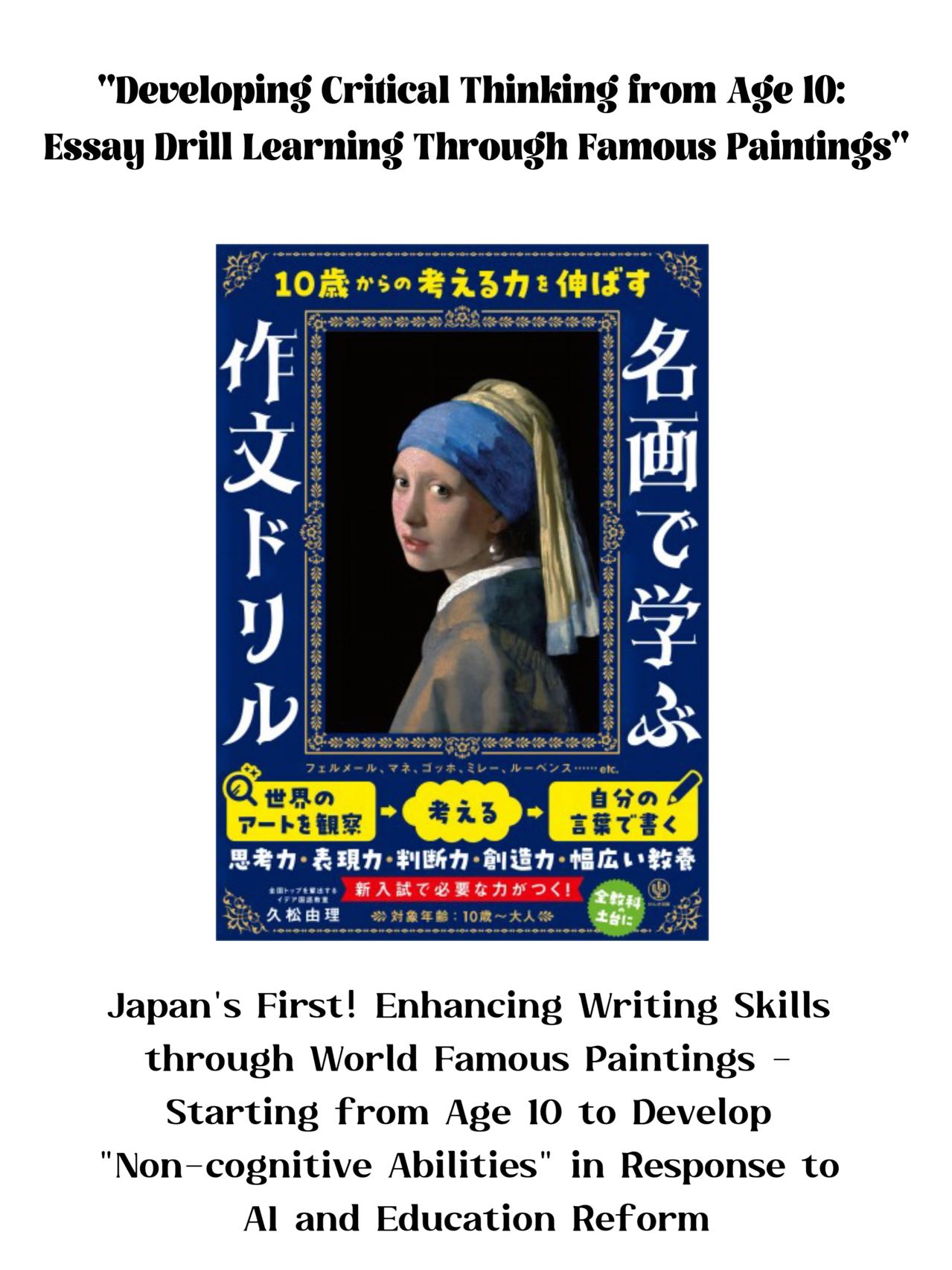
Expanding Critical Thinking from Age 10
Essay Writing through Famous Paintings
Rights Sold
Description
Awards & Endorsements
Author(s)

Yuri Hisamatsu
Related Titles


Expanding Critical Thinking from Age 10
Essay Writing through Famous Paintings
CA-LINK International LLC (Publisher)
Arts, Crafts & Makerspace · General Juvenile Nonfiction
About the Book
Japan's First! Enhancing Writing Skills through World Famous Paintings - Starting from Age 10 to Develop "Non-cognitive Abilities" in Response to AI and Education Reform
This is a book centered around world-famous paintings, aimed at helping children engage in observation, critical thinking, and essay writing exercises.
The author believes that the fundamental reason why writing cannot be effectively executed lies in the lack of "cultivated emotional sensitivity" and "underdeveloped abilities in observation, critical thinking, and imagination." For years, the author has been practicing this innovative educational approach in their own classroom, drawing inspiration from language education methods in the United States and the United Kingdom, fostering "new academic capabilities" and "non-cognitive abilities" through reading, writing, philosophy, art, and other means.
In this book, children will find numerous essay exercises designed to cultivate the adaptability required for the new era through appreciation of art. This method of enhancing writing skills through genuine artistic works is an innovation originating from Japan.
What are the abilities needed to adapt to the new era?
To survive in this future era filled with unpredictability, we need to cultivate "the ability to think about questions without answers," "the judgment to handle unknown situations," "the ability to express one's own values," and other "new academic capabilities."
Even with the significant advancements in AI, human-exclusive abilities remain irreplaceable, such as empathy, imagination, creativity, communication skills, desire to learn, and humanity, collectively known as "non-cognitive abilities."
Japanese schools and entrance exam preparatory institutions have long regarded the ability to memorize knowledge and efficiently solve specific problems as hallmarks, labeling children who possess these skills as "excellent."
In recent years, Japan has introduced a comprehensive evaluation system for entrance exams, including "non-cognitive abilities," conducting a comprehensive assessment of these skills and beginning to place importance on them.
This book, through the medium of "art," allows children to engage in observation, critical thinking, and essay writing exercises. While honing their writing skills, the book also cultivates the ability to think and express oneself in their own language, as well as observational and critical thinking abilities.
Its characteristic methods include:
"Artistic observation essays," accurately documenting observed content into articles.
"Artistic reasoning essays," contemplating questions without answers using art as clues.
"Artistic narrative creation," weaving stories from art.
Yuri Hisamatsu
Representative of Contract Company Idea
Director of Idea Language Classroom. Feeling the crisis of declining language abilities among young people year by year, under the slogan of "Get rid of rote learning! Cultivate thinking children," I opened a Mandarin tutoring class specializing in reading and composition in 2010.
Through the "Article Writing Development Method" and "Observation Training" created from my experience as a former news reporter, students' narrative and reading abilities have made tremendous breakthroughs, and we have successively cultivated students who have been admitted to nationally renowned prestigious schools.
From a small classroom with only six desks, we have cultivated four students who ranked first in the national Chinese language mock exams in the past three years.
Admission Results in 2022: Second in the Faculty of Science at the University of Tokyo, Keio University School of Medicine, Hokkaido University School of Dental Medicine and School of Fisheries, etc.
Admission Results in 2023: Faculty of Dental Medicine at Tokyo Medical and Dental University, Faculty of Sociology at Doshisha University, Keio NY College, etc.
Others: First in the national Nihon Kentei Chinese language test, third in the nationwide Yotsuya Otsuka Unified Academic Ability Test, etc.
The new curriculum that uses philosophy and art to train non-cognitive abilities also performs strongly in the new trend entrance exams,
and has an astonishing admission rate in the special entrance exams of prestigious universities.
Currently, besides providing individual Mandarin guidance at the Tokyo-Mita and Kochi campuses,
we also conduct lecture activities under the theme of "Learning Mandarin to Become a Happy Person," and provide home tutoring services to elementary schools.
Published works include "Cultivating Children's Observation Skills: Cultivating Children's Ability to Observe the Underlying Logic of Things" (Kanki Publishing).
Current Licenses
World Wide Rights Available
Awards & Endorsements
Review
Question: The girl in the painting seems to want to say something as she turns her head and gazes at you. What exactly does the girl want to convey? Observe the scene and try to fill in the blanks below to have a conversation with the girl.
Through observing the painting "_____" by (painter's name), I feel the girl in the painting is saying to me:
"The girl says: _____."
Review
Can you become a famous detective? Use analysis and deduction to reason.
Analysis and deduction refer to the method of narrowing down the image of a suspect based on various data when the police are searching for a criminal, etc. This time, let's try to use the painting below to attempt "analysis and deduction."
Question 1: Carefully look at the painting above and write down the facts you can...
Review
The painting in the example question is believed to have been "seen" by many people, but how many have actually written while reasoning?
Attempting to write will make you realize that "writing" is an activity that requires profound thought.
For detailed information on why such training is helpful in improving language skills, please refer to the previous work "Cultivating Children's 'Observation': Cultivating Children's Ability to Observe the Underlying Logic of Things from an Early Age" (国语の成績は観察力で必ず伸びる).
The painting known as "The Bedroom in Arles" is actually painted by the Dutch-born painter Vincent van Gogh. When it comes to Van Gogh, many people may be familiar with his famous work "Sunflowers." From the painting, you can see his unique feeling in the use of colors indoors.
Van Gogh moved to the city of Arles in France around the age of 35 and lived together with the painter Gauguin in a rented house called the "Yellow House."
The two influenced each other's paintings, working energetically, but only two months later, they had a fierce quarrel. During the argument, Van Gogh lost his ear, and Gauguin left the house.
There is a theory that Gauguin used a fencing sword to cut off Van Gogh's ear, and there is also a theory that Van Gogh cut off his own ear and took it to a nearby woman. Therefore, he was considered mentally ill and was admitted to a hospital.
During his lifetime, his paintings were almost unsold, and at the age of 37, Van Gogh ended his life with a gun. If he knew how popular he is now, he would surely be happy.
Question 1: Essay Example
The walls of the room are light blue, with two blue doors on each side.
There is a wooden bed on the right side of the room, with two pillows. The sheets are white, and the bedspread is red.
There is a green window frame deep in the room, with the window slightly open and bright outside.
There are two wooden chairs in front and back of the room, with yellow and green seat cushions.
There are five paintings hanging on the wall, three of which are portraits.
On the wall by the window, there is a mirror and a towel, and there are small items such as a kettle and cups on the small wooden table.
There are wooden hooks on the wall behind the bed, with three blue coats and a straw hat hanging on them.
The floor is brown and looks a bit worn.
Question 2: Essay Example (Grade 9)
I deduce that the occupant of this room is a man with some unusual feelings. Because the color combination in the room is quite unique. Although it may be inevitable to have blue walls and doors in a rented room, I wouldn't put green chairs in that blue room, nor would I use a red bedspread. However, despite using such rich primary colors, the room l...